Order Types and Their Impact on Price
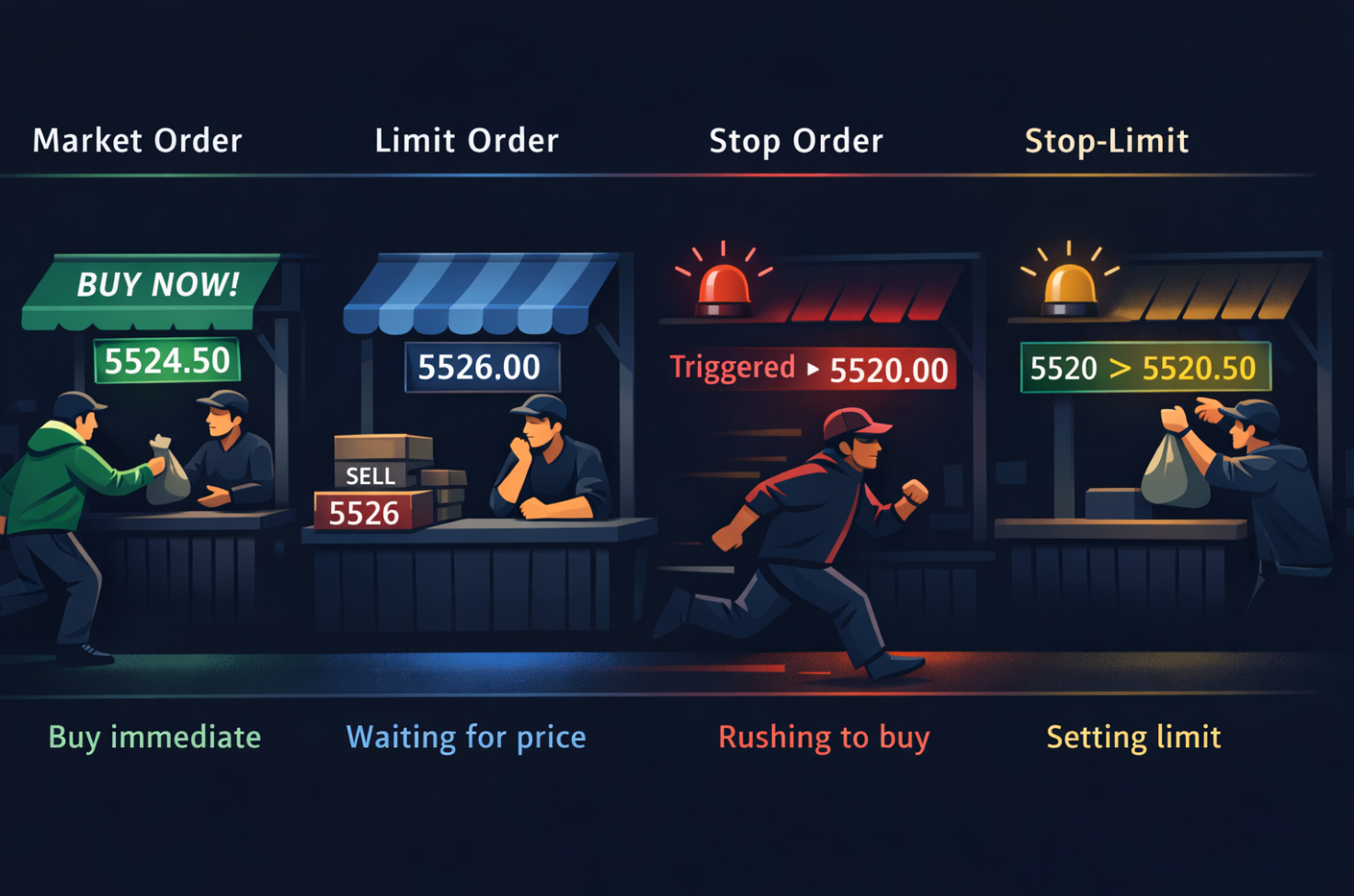
Every order on the exchange is a choice between two trade-offs: guaranteed execution or price control. Understanding these trade-offs is the key to reading order flow.
Futures Essentials
Volume analysis works best where every trade is visible. CME futures are the gold standard: one exchange, all data available to all participants.
Tick Size and Value
A tick is the minimum price increment. Each instrument has its own:
| Instrument | Tick | Tick Value |
|---|---|---|
| ES (E-mini S&P 500) | 0.25 points | $12.50 |
| NQ (E-mini Nasdaq) | 0.25 points | $5.00 |
| CL (WTI Crude Oil) | $0.01 | $10.00 |
"ES moved 10 ticks" = $125 per contract.
Continuous Contract
Every futures contract expires. ES does so quarterly: March, June, September, December. A few days before expiration, liquidity migrates to the next contract -- the rollover. For analysis, traders use a continuous contract -- a "stitched" series of consecutive contracts forming an unbroken data feed.
During rollover, expect volume spikes and anomalies: liquidity is split between the old and new contract, both order books are thinner than usual, and order flow signals are less reliable. Happens quarterly, lasts a couple of days.
Market Order: "Walk Up and Take It"
The buyer walks up and takes the goods at the current price. No haggling. Takes what is available. A market order moves price when its size exceeds the liquidity at best bid/ask.
The trade-off: execution is guaranteed, price is not. On a liquid market, slippage is one tick. On a thin market, price can slip 5-10 ticks -- that is slippage.
Limit Order: "Set the Price and Wait"
The seller set a price tag and sits. He will not go to the buyer -- he waits for buyers to come to him. A limit order creates liquidity -- "goods on the counter." It does not move price by itself.
The opposite trade-off: price is guaranteed, execution is not. You know the price you will get if the market reaches you. But it might not.
A stop-loss is almost always a market order -- when protecting a position, getting out matters more than getting out at a good price. Take-profit is almost always a limit -- there is no rush.
Stop Order: "The Alarm Went Off -- Run and Buy"
The buyer sits in a cafe across the street. He left an assistant with instructions: "If the price reaches 105 -- run and buy, whatever it costs." This is a stop order. While price is below 105, nothing happens. Once it hits -- the assistant runs and buys at market.
A stop order turns into a market order when triggered. And like any market order, it moves price. This is why stop cascades are so powerful: when price reaches a cluster of stop orders, they all convert to market orders simultaneously. A wave of market orders eats through liquidity level by level.
Example. ES consolidates between 5520 and 5525. Below 5520, stop-losses of long positions accumulate. Price breaks 5520 -- stops convert to sell market orders. The flood of market sells hammers the bid. Price drops 3-4 ticks in one second. The footprint shows massive volume on the bid side. This is not "sellers deciding to sell" -- it is a stop cascade.
Stop-Limit Order: "The Alarm Went Off, but Set a Price"
Same assistant, different instruction: "If the price reaches 105 -- set a price tag at 105.50 and wait." A stop-limit turns into a limit order when triggered, not a market order. If price blew past too quickly, the limit just hangs in the book unfilled.
On fast markets (news releases, session opens), a stop-limit may fail: price jumped past the limit in a single tick.
- Market order: guaranteed execution, but price may slip
- Limit order: exact price, but may never fill
- A stop order becomes a market order when triggered -- it moves price
- Stop cascades are one of the most powerful forces in the market
- A stop-limit controls price but risks not filling on a fast market