Imbalances
Imbalances: why diagonal
POC and delta are global characteristics of the candle. Imbalances are local: they show at which specific level one side overwhelmed the other.
The principle: if aggressive buys at a level are several times greater than aggressive sells one level below, that is an ask-side imbalance. Buyers crushed the defense. If the opposite is true, it is a bid-side imbalance.
But why "one level below"? Why do we compare diagonally rather than horizontally?
Because at the moment of a trade, the order book is structured so that the best ask and best bid are separated by a one-tick spread. When an aggressive buyer hits the ask at 5525.50, the nearest bid at that moment is 5525.25 (one tick lower). The passive seller who could have opposed that buy was resting with a limit order at 5525.25. This is why the comparison is diagonal: it reflects the actual mechanics of the order book.
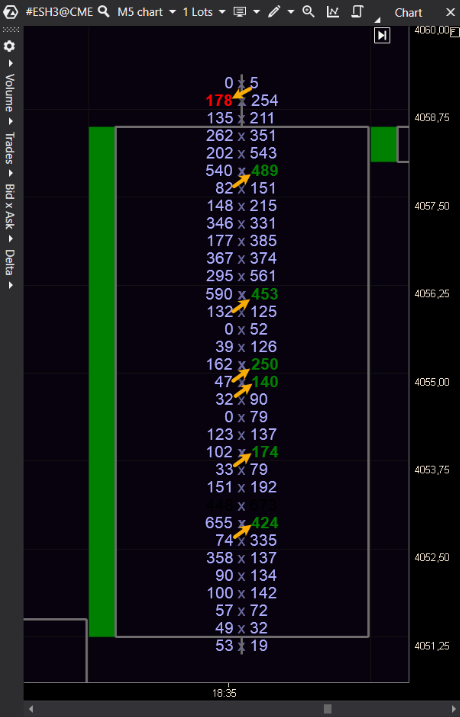
The rule: if the ratio is >= 2x (200%) — it is an imbalance, one side is twice as strong. If >= 4x (400%) — it is a strong imbalance, outright domination. The 200% and 400% thresholds are standard; they can be adjusted for a specific instrument and timeframe if needed.
Let us check all levels of our candle. Hover over the highlighted cells — green at the top (buy imbalances) and red at the bottom (sell imbalances):
Sell imbalances:
| Level (bid) | Bid | vs Ask (level above) | Ratio | Imbalance |
|---|---|---|---|---|
| 5524.75 | 85 | vs 24 (@ 5525.00) | 3.5x | 200% |
| 5525.00 | 310 | vs 75 (@ 5525.25) | 4.1x | 400% |
| 5525.25 | 240 | vs 295 (@ 5525.50) | 0.8x | none |
Buy imbalances:
| Level (ask) | Ask | vs Bid (level below) | Ratio | Imbalance |
|---|---|---|---|---|
| 5525.75 | 340 | vs 110 (@ 5525.50) | 3.1x | 200% |
| 5526.00 | 52 | vs 18 (@ 5525.75) | 2.9x | 200% |
Two clusters. At the bottom — sell imbalances: sellers dominated at 5524.75 and 5525.00. At the top — buy imbalances: buyers pressed at 5525.75 and 5526.00. The middle — no imbalances, an equilibrium zone.
The candle told its story in four numbers (OHLC). The footprint told it in twenty. And the story turned out to be more complex.
- Imbalances are compared diagonally: ask at level P vs bid at level P-1
- Diagonal comparison reflects the actual mechanics of the order book (best ask vs best bid)
- The 200% (2x) threshold marks an imbalance; 400% (4x) marks a strong imbalance
- Imbalances show local domination, not global direction