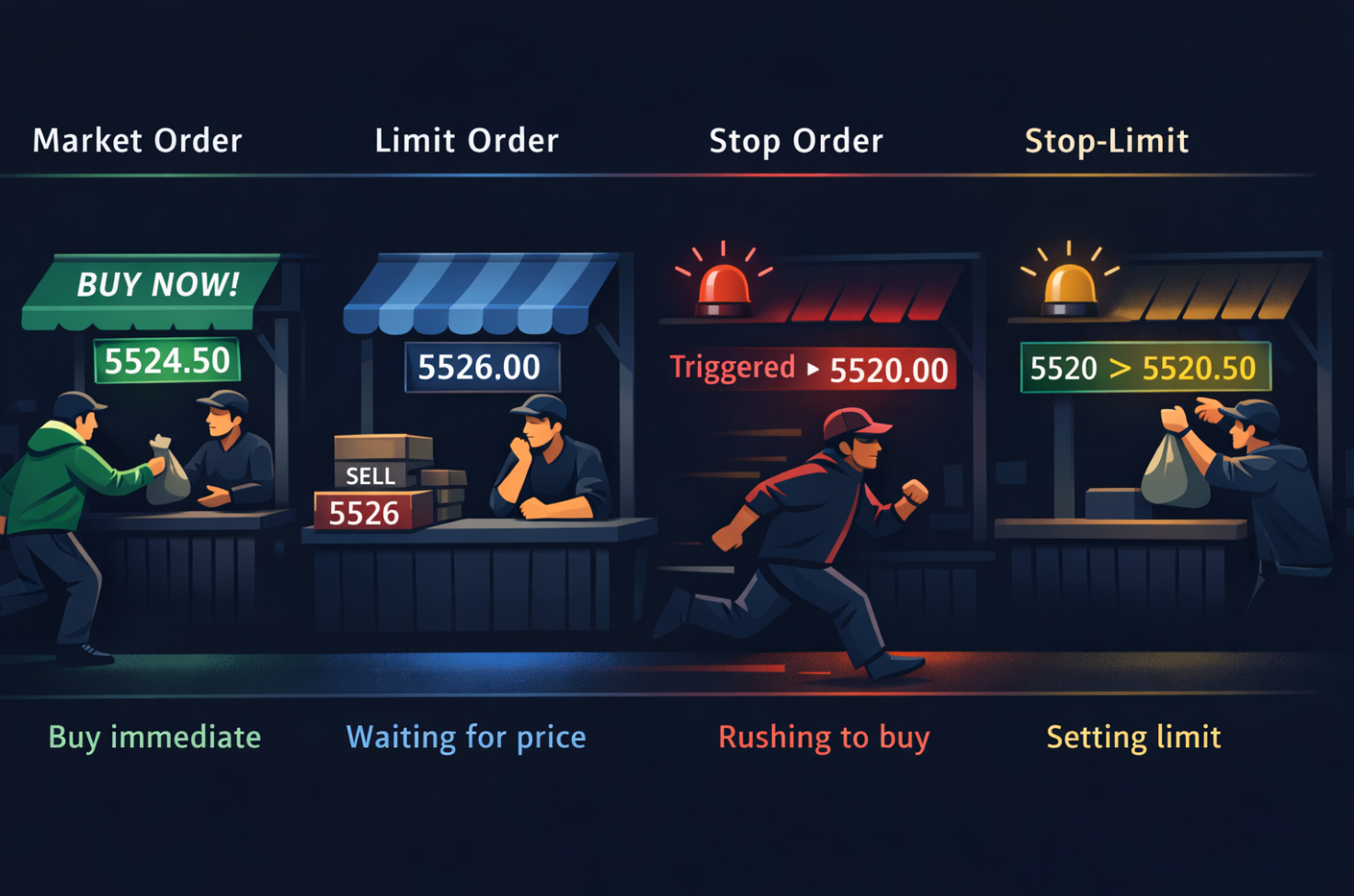
Every exchange order solves only one task: you either want to enter right now or at a specific price. You cannot have both at the same time. This is the choice behind every order type.
Futures Basics
Volume analysis works best where every transaction is visible. CME futures are the gold standard: one exchange, with the same data available to all participants.
Tick Size and Tick Value
A tick is the minimum price increment. It differs for each instrument:
| Instrument | Tick | Tick value |
|---|---|---|
| ES (E-mini S&P 500) | 0.25 points | $12.50 |
| NQ (E-mini Nasdaq) | 0.25 points | $5.00 |
| CL (WTI crude oil) | $0.01 | $10.00 |
“ES moved 10 ticks” = $125 per contract.
Continuous Contract
Every futures contract has a limited lifespan. ES expires four times a year: in March, June, September, and December. A few days before expiration, liquidity shifts to the next contract — this process is called rollover. There is little value in analyzing separate three-month fragments. That is why several contracts are combined into a single data series known as a continuous contract. This is what you see on most charts.
During rollover, liquidity is split between the old and new contracts. The order book for each contract becomes thinner than usual, volumes may behave abnormally, and order flow signals are less reliable on those days. Fortunately, this happens once per quarter and usually lasts only a couple of days.
Market Order: “Walk Up and Take It”
A market order means “I want it right now.” You enter the market and take the price currently available. Execution is guaranteed; price is not. In a liquid market, this is usually not a problem: the difference between the expected and actual price may be one tick. But in a thin market, the price can move 5–10 ticks while the order is being filled. This is called slippage.
Limit Order: “Set a Price and Wait”
A limit order means “I want it at my price.” You set the price and wait for the market to come to you. Limit orders are what create liquidity in the order book — the same “goods on the counter” from the previous lesson. The price is guaranteed; execution is not. You know the price at which the order will be filled if the market reaches your level. But the market may reverse before that happens, and the order may remain unfilled in the order book.
A stop-loss is almost always a market order because protecting a position makes execution more important than getting an ideal price. A take-profit is almost always a limit order because there is no need to rush.
Stop Order: “The Alarm Goes Off — Start Buying”
A buyer is sitting in a café across the street. They leave an assistant with the following instruction: “If the price reaches 105, go and buy, no matter what it costs.” This is a stop order. While the price remains below 105, nothing happens. As soon as it reaches 105, the assistant goes and buys at the market price.
When triggered, a stop order becomes a market order. And like any market order, it moves the price. This is why stop cascades can be so powerful: when the price reaches a cluster of stop orders, they all turn into market orders at the same time. A wave of market orders consumes liquidity level by level.
Example. The ES price consolidates between 5520 and 5525. Stop-loss orders from long positions accumulate below 5520. The price breaks below 5520, and the stops turn into sell market orders. The flow of market sells hits the bid. The price drops by 3–4 ticks in one second. The footprint shows large volumes on the bid side. This is not simply “sellers deciding to sell” — it is a stop-loss cascade.
Stop-Limit Order: “The Alarm Goes Off, but I Still Set a Price”
The same assistant receives a different instruction: “If the price reaches 105, place an order at 105.50 and wait.” When triggered, a stop-limit order becomes a limit order rather than a market order. If the price moves past it too quickly, the limit order will remain unfilled.
In fast markets, such as during news releases or the session open, a stop-limit order may not be filled: the price can jump past the limit price in a single tick.
- Market order: execution is guaranteed, but the price may slip
- Limit order: exact price, but execution is not guaranteed
- When triggered, a stop order becomes a market order and moves the price
- A stop cascade is one of the strongest forces in the market
- A stop-limit order controls the price but may remain unfilled in a fast market